The Street-Name Shortcut That Sends Readers the Wrong Way
Clear street-name directions pair an ambiguous road name with a precise destination and route wording, helping readers distinguish the intended street.
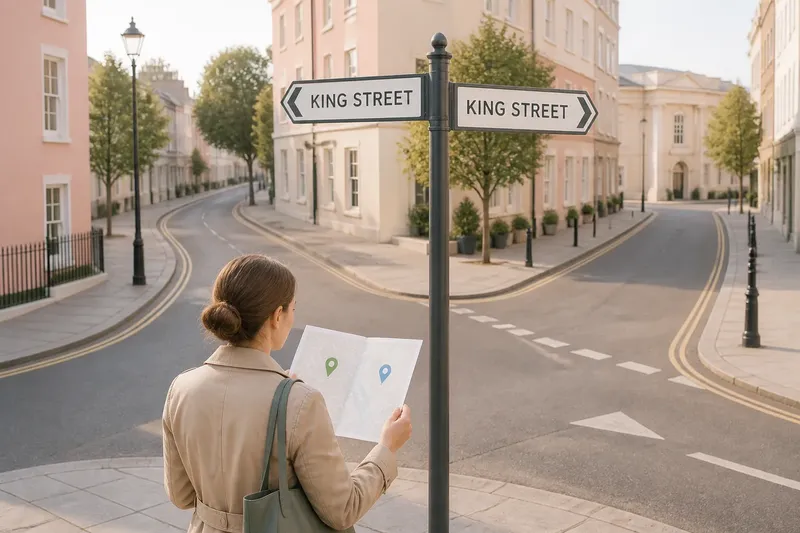
At a junction, someone reads “King Street” on a direction sheet and finds two roads with that name. Clear street-name directions need to resolve the name ambiguity: which King Street, which destination, and what the route is called in the language used locally.
The useful work is editorial, not a lesson in spotting signs while walking. Check official street names, distinguish duplicated names and choose wording that agrees with maps, local signage and the destination’s own name. A route should not quietly invent a second naming system.
Why can one street name refer to two routes?
Duplicate street names occur within a city, while a single street can also have a formal name, a local name and a name used by a transport operator. Similar names can differ only by a suffix, such as “Road” and “Street”, or by a directional label such as “North”. These distinctions matter in written directions because readers may reasonably treat similar labels as the same place.
Begin with the authoritative street-name source used by the relevant council or mapping authority. Compare the full name, including its suffix and any directional term, with the names shown on the route’s map and destination information. If those sources disagree, resolve the naming discrepancy before drafting the instruction; adding a vague landmark does not make conflicting names agree.
Which name should the route use?
Use the name a reader can verify in the setting where they will follow the route. A route map should match the street label on the map; directions tied to public signs should use the sign’s official wording. If a familiar local nickname helps, put it alongside the formal name once, such as “Market Road, known locally as the Old Market Road”, only when that relationship is confirmed and useful.
Do not shorten a name in a way that creates another plausible street. “St Mary’s” may refer to a church, a street or a station in the same area. Spell out enough of the official name to distinguish it, and use the same form throughout the route.
How can destination wording disambiguate a street?
Add a destination when the street name alone leaves more than one route plausible. “King Street towards the station” is clearer than “King Street” if only one of the two King Streets leads to the intended station entrance. If the station has several entrances, name the relevant one using its published label.
Destination wording should describe the actual route, not merely a nearby place. “Towards the museum” is unhelpful if both branches pass the museum, or if neither reaches the entrance the reader needs. Where a destination does not distinguish the routes, use the street’s full name or a verified route label instead.
What wording questions should you settle before publishing?
Should the full street name always be used?
Use the full official name when shortening it could cause confusion. A shorter form is suitable only when the map, sign or local naming convention makes the reference unmistakable.
What if maps and street signs use different names?
Check the name with the responsible local authority or map publisher, then make the route’s source clear and consistent. Do not combine competing labels as though they were interchangeable.
Can a landmark replace an ambiguous street name?
A named landmark can help distinguish a route if it is officially identified and relevant to the destination. It should not replace a street name that readers need to match against a map or address.
What if both branches lead to the same destination?
State which branch the route intends to use only if there is a practical reason to prefer it, such as a named entrance or an accessible approach. Otherwise, identify the destination clearly and avoid implying that one branch is the sole route.
How should you audit names and route wording?
For each street name in a draft, record the source, the possible ambiguity and the decision that follows. This keeps the review focused on names and meanings rather than on when a sign becomes visible.
- Official name: Check the council or mapping authority’s full street label. If it matches the draft, keep it; if it differs, replace the draft name with the authoritative form and confirm that the map uses the same form.
- Duplicate name: Check whether another street in the city has the same name. If it does, add a distinguishing destination or verified area label; if it does not, retain the name without an unnecessary qualifier.
- Street suffix: Compare “Road”, “Street”, “Lane” or another suffix against the official label. If the suffix differs, correct it; if it matches, use it consistently in every instruction.
- Directional term: Check whether “North”, “Upper” or another modifier belongs to the formal name. If it does, include it; if it is only informal, omit it unless an authoritative source confirms the alternative.
- Destination name: Compare the destination wording with the venue’s published name and entrance labels. If the route means a particular entrance, name that entrance; if no entrance distinction matters, use the venue name alone.
- Nickname: Check whether a local alias is established and understood in the route’s intended context. If confirmed and helpful, pair it with the official name once; if uncertain or likely to confuse, leave it out.
How does a name audit change a finished direction?
Say a route editor has a draft reading “King Street to the station”. The starting information is a city map with two King Streets, an authority listing that distinguishes them as King Street and King Street North, and a station guide naming the required entrance “North Gate”. The editor checks those three sources, changes the direction to “King Street North to the station’s North Gate”, then compares the revised wording with the map legend. The result is a route name and destination that distinguish the intended street and entrance; the trade-off is a longer instruction, but it avoids relying on an unexplained shortcut.
Read the final route names as a set, not as isolated phrases. Consistent labels make a map and its directions easier to compare, much as matching labels on a key ring make it clear which key belongs to which door. If an official name remains disputed or a local naming rule applies, ask the relevant authority rather than resolving it by editorial preference. Clear street-name directions are specific enough to distinguish the intended route and faithful to the names readers can verify.