A Market-Day Route, Planned Around Meeting Points
Plan a market-day route around clear meeting points, so companions can regroup calmly when stalls, crowds or missed turns separate the group.
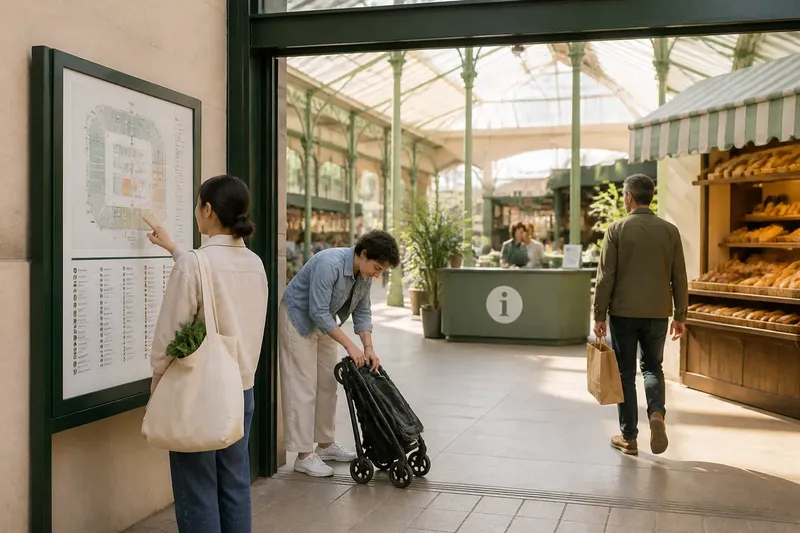
A market-day route is easier to resume when everyone knows where the next pause will be. At a covered market entrance, one person is reading the stall directory, another is folding a buggy, and someone else has already turned towards the bread. Agreeing on a few regrouping places gives those different rhythms a workable shape.
The aim is not to keep everyone in formation. It is to decide where the group will pause, check who is present and choose what to do next. Think of each point as a bookmark: it helps everyone return to the same place in the plan without requiring them to read every page together.
Why does a market group split at the entrance?
Entrances bring several decisions at once: which doorway to use, where the queues begin and whether to read the directory now or later. A clear first pause prevents those small choices from turning into separate routes.
Name the first meeting point before setting off and identify it in person. “By the directory beside the market office” is more precise than “at the entrance”, which may refer to several doorways or corners. Choose a place where people can wait without blocking a queue or narrowing a passage.
If the obvious spot is busy, select a nearby edge where the entrance remains in view. Say exactly where it is, rather than asking late arrivals to find “somewhere nearby”.
How do you choose a meeting point that works?
For a market visit, the useful test is operational: can the group reach, occupy and leave the spot without obstructing other people? A fixed directory, public information desk or named gate may work well. A seller’s display or temporary canopy may not; it can move, close or become hidden behind a queue.
- Check the space around the point: if people can wait clear of queues and doorways, use it; if not, choose a nearby open edge.
- Check how it is described: if everyone can identify it by the same name or feature, keep it; if descriptions vary, select a more distinct nearby place.
- Check the approaches: if companions can reach it without crossing a restricted or congested area, use it; if not, choose a point on their side of that obstacle.
- Check whether it depends on a stall: if the location stays clear when sellers change, keep it; if it relies on a temporary display, replace it with a fixed part of the building or market.
- Check the waiting conditions: if the point has room and, where needed, nearby seating, use it; if someone would have to stand in the flow, choose a more comfortable place.
- Check whether help is easy to find: if a market worker or information desk is nearby, note that option; if not, agree on a public staffed point as the fallback.
A point need not be impressive. It needs to be usable by the people who are meeting there, which is a less glamorous standard and a more useful one.
How should you divide a market route?
Begin with the entrance, the areas the group wants to visit and the intended exit. On a paper sketch, mark the main passage, the crossings between sections and the agreed pause points. Avoid plotting a turn at every stall: queues and temporary displays can make that sort of precision short-lived.
Give each part of the route a plain purpose: enter and orient, browse one section, regroup, then decide whether to continue or leave. This makes it easier to shorten the visit without sending anyone back through the whole market to find the others.
Say you are meeting a friend at a covered produce market. You both start beside the directory at the west entrance, plan to browse the central produce aisle, regroup at the information desk before the outdoor food area, then leave through the courtyard gate. Your friend stops at a book stall; because the desk is the next agreed point, the decision is to continue there rather than search every aisle. If the desk is blocked, you have already named the west entrance directory as the fallback, so the route remains clear without relying on a message arriving.
What should happen when someone browses separately?
Agree on the rule before anyone wanders off: a person who separates returns to the next named point, rather than guessing which aisle the group chose. The main group should also know whether it will wait there briefly or continue to the following point.
Make that arrangement fit the people in the group. If someone cannot comfortably keep moving or needs longer, pause and make a new plan together. The purpose is to reduce uncertainty, not to turn a market visit into a timed exercise.
What if a meeting point is blocked?
A queue, delivery trolley or temporary barrier can make a planned spot unusable. Agree on a backup while everyone is together, and describe it by a fixed feature, such as the directory beside the west entrance. Keep the alternative on the same side of likely barriers where possible.
If both agreed places are inaccessible, ask market staff or the information desk for help rather than searching unfamiliar aisles. A phone message can be useful, but it should not be the only way to change the plan; someone may have no signal, a flat battery or a bag occupying both hands.
Which market-route questions come up most often?
How many meeting points does a market route need?
Choose enough points to make the route easy to resume, without scheduling every aisle. A starting point, a regrouping place between sections and a clear exit are often sufficient for a simple visit.
Should the meeting point be indoors or outdoors?
Use the side that is easier to reach and wait at without adding a bottleneck. If the group may split between the hall and an outdoor section, name the exact doorway and which side of it you mean.
What should someone do if they cannot find the group?
Go to the next agreed point and wait somewhere that does not obstruct others. If it is blocked, use the named backup; if both are inaccessible, ask market staff for assistance instead of continuing to wander.
Can a phone map manage a route through the market?
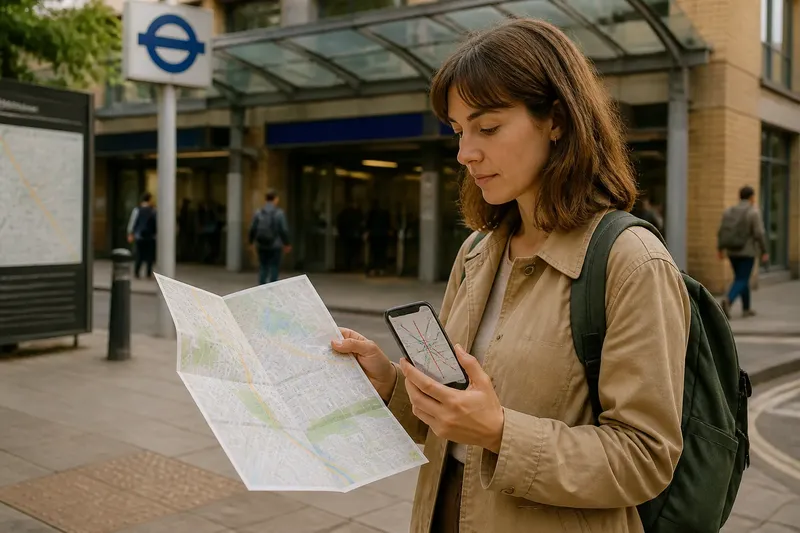
A phone map can help with the streets around the market, but it may not show internal passages, temporary closures or the precise side of a doorway. Use it alongside a route agreed in plain words, not as the only meeting plan.
How can the plan stay usable for everyone?
Before setting off, consider whether the route includes steps, narrow passages, seating and places to rest. If the market has an accessible entrance or lift, check that it is open and connects to the sections the group plans to visit; ask staff if current access arrangements are unclear.
Give children and anyone without a phone the name of the next point and a simple way to ask for help. Agree that they should stay in a public area and approach a market worker or information-desk staff member if separated.
A market-day route is most useful when each pause has a clear purpose: regroup, check whether the planned section is workable, then choose to continue, change direction or leave. That decision is easier when the meeting point is specific and the backup is already agreed, even if the day’s most persuasive stall is selling something that was not on the list.